
The Complete Guide to Vehicle Air Conditioning: Re-Gassing, Leaks, and Repairs
There are few things more miserable than being stuck in heavy traffic during a blistering South African summer with a broken car air conditioner. When the cabin temperature creeps past 35°C and your vents are only blowing hot air, getting your climate control sorted goes from a luxury to an absolute necessity.
While many drivers hope for a quick and cheap fix, the reality of automotive HVAC (Heating, Ventilation, and Air Conditioning) systems is highly technical. Here is the candid truth about how your car's aircon works, why it fails, and what a professional repair actually involves.
The Big Misconception: "It Just Needs a Re-Gas"
Let us address the most common myth in auto repair: Your car’s air conditioning system does not consume refrigerant gas. An automotive AC system is a completely closed, sealed loop. Unlike petrol or engine oil, the refrigerant gas (usually R134a or the newer R1234yf) is never "used up" or burned away. If your system is low on gas, there is only one reason: you have a leak. Simply paying for a cheap "top-up" or re-gas without finding the leak is throwing your hard-earned Rands away. The new gas will eventually leak out again—sometimes in a few months, sometimes in a few days. A reputable workshop will always insist on a pressure test and leak detection before adding new refrigerant.
Common Signs Your Aircon Needs Professional Attention
Don't wait for the system to fail completely. If you notice any of these symptoms, it is time to consult our auto repair directory:
-
Blowing Warm or Mild Air: The most obvious sign of low refrigerant or a failing AC compressor.
-
Musty, Damp Odours: If your car smells like old gym socks when you turn on the AC, mould and bacteria have built up on your evaporator core behind the dashboard.
-
Strange Noises: A loud squealing or grinding noise when you engage the aircon usually points to a worn compressor clutch or a failing pulley bearing.
-
Puddles Inside the Cabin: If you notice water pooling in the passenger-side footwell, your AC drain tube is likely blocked, causing condensation to back up into the car.
The Professional Repair Process: Step-by-Step
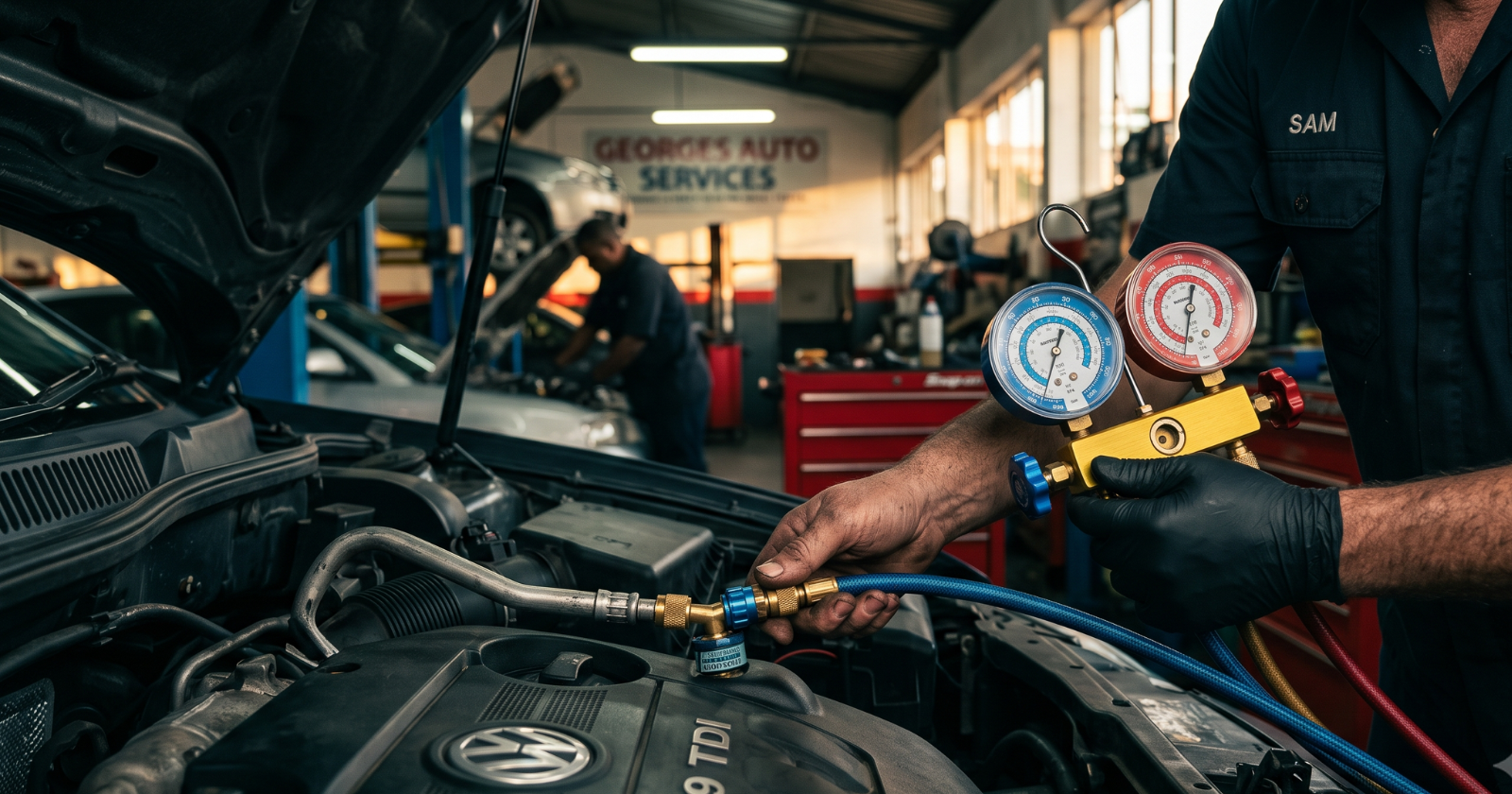
A certified automotive HVAC technician uses specialized equipment to diagnose and repair your system safely and legally, as venting refrigerant gas into the atmosphere is an environmental hazard.
-
Recovery: The technician uses a specialized machine to safely extract and weigh any remaining old refrigerant from the system.
-
Leak Detection: If the system is empty or low, the technician will pump it with an inert gas (like Nitrogen) or a UV dye to find the exact source of the leak. Common culprits include cracked rubber hoses, porous condensers (often damaged by stone chips through the front grille), or worn O-rings.
-
Component Repair/Replacement: The faulty component is replaced. If the compressor has failed internally, the entire system must be flushed to remove microscopic metal shavings before installing the new unit.
-
Vacuuming: The system is hooked up to a vacuum pump for at least 30 to 45 minutes. This boils off and removes any microscopic moisture from the lines. Moisture is the enemy of an AC system; if it mixes with the refrigerant, it creates a highly corrosive acid.
-
Re-Gassing and Lubrication: The system is finally recharged with the exact factory-specified weight of pure refrigerant, along with the correct amount of PAG oil to keep the compressor lubricated.
Understanding Air Conditioning Repair Costs
The cost of an AC repair varies wildly depending on the root cause of the problem.
| Repair Type | What to Expect | Estimated Expense Level |
| Simple Re-Gas & Dye Test | Vacuuming the system, adding UV dye, oil, and fresh refrigerant. | Low to Moderate |
| Condenser Replacement | Replacing the radiator-like unit at the front of the car, followed by a full re-gas. | Moderate |
| Compressor Replacement | Replacing the heart of the system, flushing lines, and re-gassing. | High |
| Evaporator Replacement | The most labour-intensive job, as it often requires the entire dashboard to be removed. | Very High |
Find an RMI-Approved AC Specialist
Because of the high pressures, hazardous gases, and precision required, vehicle air conditioning repair is not a DIY job.
Use our Auto Repair Directory to find trusted, RMI-approved and MIWA-registered workshops that specialize in automotive climate control. A qualified specialist will have the right electronic diagnostic tools, the correct recovery machines, and the expertise to keep your car ice-cold for years to come.
Like the article?
Join the conversation!
This is a space for respectful conversation. Let's keep all comments productive and inclusive.